Composers

Mieczsław Weinberg - Sergei Prokofiev - Szymon Laks - Alexander Krein - Osvaldo Golijov - Joel Engel - Leo Zeitlin - Mikhail Gnesin - Solomon Rosowsky


Mieczsław Weinberg


Mieczsław Weinberg
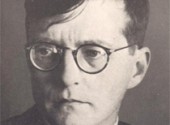
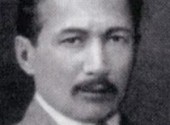
Mieczsław Weinberg, also known as Moisei or Moyshe Vaynberg (1919-1996) is surely one of the twentieth century's most important and least known composers. He was born in Warsaw, the son of a violinist and Yiddish theater music director and graduated from the Warsaw Conservatory with a degree in piano in 1939. That year Weinberg fled the Nazi invasion of Poland, settling in Soviet Minsk, where he studied composition at the Belorussian State Conservatory. After Hitler's invasion in 1941, he relocated again, to Tashkent in Soviet Central Asia. There he met his wife, daughter of the Soviet Jewish theater director and political leader Solomon Mikhoels.

In 1943, Weinberg's first symphony came to the attention of Soviet composer Dmitri Shostakovich. The result was an immediate friendship that subsequently defined Weinberg's musical and personal life. With Shostakovich's assistance, he moved to Moscow, quickly establishing himself as the latter's junior colleague in the world of Soviet composers of the 1940s and 1950s. Over the next several decades Shostakovich and Weinberg developed an extremely close friendship and artistic conversation that influenced both men profoundly. From Shostakovich Weinberg acquired an aggressive modernist musical style, while the older musical master appears to have been directly exposed to the world of East European Jewish folk music and Yiddish poetry through his younger colleague. Both even quoted from one another's compositions in their own works.

From the mid-1940s, Weinberg wrote several works with Jewish themes, including two song cycles, both named "Jewish Songs," based on the texts of Yiddish poets Y. L. Peretz (op. 13) and Shmuel Halkin (op. 17), his clarinet sonata and quintet, and other works that drew on klezmer music and Yiddish folk song traditions of Jewish Eastern Europe. By the late 1940s, Weinberg had emerged as a leading Soviet composer. However, he soon found himself personally caught up in the Stalinist post-World War II anti-Semitic repression against Jewish cultural and intellectual figures and institutions. Weinberg's Jewish musical explorations together with familial links to high-profile regime targets such as Mikhoels and the physician Miron Vovsi led to his arrest and imprisonment in February 1953. Upon the death of Stalin one month later, he was released and went on to a highly successful and prodigious career as a composer of numerous chamber and orchestral works, including 17 string quartets, 26 symphonies, 4 operas, and more than 60 film scores.


Sergei Prokofiev


Sergei Prokofiev
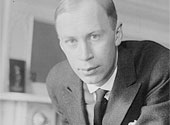
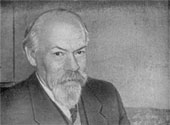
Sergei Prokofiev (1891-1953) was born in a small village in Russian Ukraine, the son of an agricultural engineer originally from Moscow. Beginning the study of piano at age three, he began to compose at six and produced his first opera when he was all of eight years old. He enrolled at the St. Petersburg Conservatory in 1904, and continued his studies for several years, quickly drawing acclaim. Following the Russian Revolution in 1917, he relocated briefly to the United States. It was there in 1919, that he composed his Overture on Hebrew Themes for a group of fellow Russian émigrés. These were the musicians of the Zimro Ensemble, Russian Jewish musicians then on a world concert tour to support the cause of establishing a conservatory in Jerusalem. Prokofiev was initially reluctant to write a piece based on material that was not his own, but warmed to the idea when he began extemporising on a collection of Jewish tunes that Bellison had given to him. The Overture was an instant success. Prokofiev expanded the scoring for full orchestra and the work has never left the repertoire.

He left the United States for Paris in 1922, and returned to the Soviet Union for good in 1932, where he remained for the rest of his life. The next years produced Lieutenant Kijé, Romeo and Juliet, War and Peace and Cinderella. In his homeland he was celebrated and honored until the 1948 crackdown on Soviet composers by the Central Committee under Stalin's orders. He died in 1953, on the same day as Joseph Stalin.


Szymon Laks


Szymon Laks
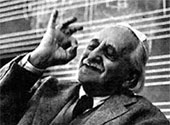
Szymon Laks (1901-1983) was born in Warsaw, studied mathematics for two years at the Vilnius University, and then entered the Warsaw Conservatory in 1921 as a violin and composition student. He left Poland in 1926 to continue his musical studies in Paris. In 1941, he was arrested by the Nazis and spent three years imprisoned at the Auschwitz and Dachau concentration camps. There he survived in part thanks to his grim, absurd assignment as a member of a concentration camp orchestra. His memories of that experience, and the role of music in concentration camp life during the Holocaust, are recorded in his memoir, La Musique d'un Autre Monde, published in Paris in 1948 and later translated into English as Music of Another World. In 1945 he returned to Paris, where he remained for the rest of his life, composing searching modern neo-classical music ranging from symphonies to lyrical song settings. His compositions often engage directly with the themes of war, destruction, and memory, and the Polish Jewish experience.


Alexander Krein
Jewish Sketches, #2, op. 13 (1910)


Alexander Krein's sheet music cover
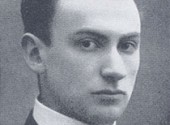
Alexander Krein (1883-1951) was one of the leading modernist composers of the Soviet Union in the 1920s and 1930s. He was born in the Russian city of Nizhni Novgorod into a family of traditional Jewish folk musicians. His father, Abraham, was a folk violinist, seven of whose ten children became professional musicians, notably David (1869-1926), the concertmaster of Moscow’s Bolshoi Theater orchestra, and Gregory (1879-1975), also a composer, in addition to Alexander.

After a childhood spent performing in his father’s band, playing klezmer music (East European Jewish folk music), Krein entered the Moscow conservatory at age thirteen as a cello student. He went on to study music theory and composition with composers Sergey Taneev and Boleslav Yavorsky. While still a student, he began to compose song settings for Russian and French symbolist poetry.

By the time he graduated in 1908, he had developed a highly original style, one which combined the new harmonic language of modern composers such as Debussy, Ravel, and in particular, Scriabin, with the lyrical melodies and distinctive modes of Jewish folk music.

This piece represents one of his first efforts in this direction, and forms part of a two-set series of Evreiskie eskizi (Jewish Sketches) for clarinet and string quartet (1909 and 1910) based on melodies from his own father’s klezmer repertoire. It was written at the behest of composer Joel Engel, who encouraged Krein to explore his own Jewish musical heritage. Published by the Moscow-based Russian music publisher Jurgenson, the piece earned immediate acclaim, establishing Krein as a major new voice in both Russian and Jewish music.

Critics were particularly struck by the use of the classical string quartet with a clarinet line that evoked the idiosyncratic melos and intonation of klezmer music, a sound sometimes said to mimic the emotive character of Jewish prayer chant, the soulful inflections once described as "laughter through tears."

Krein played a major role in the emerging school of Jewish national music as a composer and active member of the Society for Jewish Folk Music’s Moscow Branch (1913-1919) and its successor organization, the Society for Jewish Music (1923-1929).

In the Soviet era he served in a variety of roles in the Music Section of the Soviet Ministry of Education and later the editorial board of the State Music Publishing House.

Beginning in 1917 he composed extensively for the theater, including Moscow’s Hebrew-language Habimah Theater and the Moscow, Ukrainian and Byelorussian State Yiddish theaters. During the 1920s he wrote several important works, including the symphonic cantata Kaddish (1921), the First Piano Sonata (1922) and the First Symphony (1922-25).

In these compositions Krein embraced both Jewish folk and liturgical melodies as part of his search for a distinctive, non-European Jewish sound. As the Communist regime grew more and more ideologically restrictive in the late 1920s and 1930s, Krein struggled to reconcile his art with the increasing political pressures.

In spite of obvious political compromises in the form of works such as the cantata Funeral Ode in Memory of Lenin (1926) and the symphonic oratorio The U.S.S.R.—Shock Brigade of the World Proletariat (1932), Krein continued to boldly explore Jewish musical and literary themes in his work well into the 1940s.

His opera Zagmuk (1929) concerned the Jewish uprising in ancient Babylon and was staged as the first Soviet opera at the Bolshoi Theater in Moscow (1930). In 1934 he was awarded the title of Honored Artist of the Soviet Union.

As late as 1941 Krein composed music for the productions of the Moscow State Yiddish Theater and his Second Symphony (1945), a meditation on the historic sufferings of the Jewish people from ancient times through the Holocaust.


Osvaldo Golijov (b. 1960)
The Dreams & Prayers of Isaac the Blind (1994)


Osvaldo Golijov
Osvaldo Golijov (b. 1960) has emerged in the past decade as one of the most acclaimed and original composers in contemporary classical music. A Pulitzer Prize winner, he is highly regarded by critics and audiences across North America and Europe for his unique blend of traditional folk music materials and modern classical idioms.

Born in Argentina, the son of Polish-Jewish immigrants, he absorbed the sounds of traditional East European Jewish folk and religious music and the Yiddish language as well as Catholic masses, Latin American folk songs, chamber music, and the tangos of Astor Piazzolla. After study in Israel in the early 1980s with composer Mark Kopytman, he completed a Ph.D. in composition under George Crumb at the University of Pennsylvania in 1986. He himself now teaches at Holy Cross College in Massachusetts.

In the 1990s, Golijov began to work closely with the Kronos and St. Lawrence String Quartets in a quest to rethink the canon of classical music from the outside in, combining various folk and pop genres with the conventional language of the string quartet.

The first major effort in this direction was The Dreams & Prayers of Isaac the Blind, which immediately drew critical and popular acclaim for its pairing of the klezmer clarinet idiom (in a much more dramatic fashion than Krein, it should be noted), with a string quartet. Golijov’s piece also draws on Jewish mystical religious traditions to evoke the esoteric world of kabbalah, a tradition of intimate communion with God through special, secret prayers and other unconventional religious rituals.

Golijov has gone on to great acclaim through his St. Mark’s Passion (2000), written to commemorate the 250th anniversary of J. S. Bach's death, and featuring the Schola Cantorum of Caracas, jazz and folk musicians, dancers, and a symphony orchestra.

In recent years he has also worked with Dawn Upshaw and the Atlanta Symphony Chorus and Orchestra, including on the opera Ainadamar, which won Grammy awards for best opera recording and best contemporary composition.

Other projects have involved artists such as vocalist Luciana Souza, cellists Maya Beiser, Alisa Weilerstein and Matt Haimovitz, the Romanian Gypsy band Taraf de Haidouks, the Mexican Rock group Café Tacuba, and tablas virtuoso Zakir Hussain.

He is composer-in-residence for the 2007 Mostly Mozart Festival at Lincoln Center and the Chicago Symphony Orchestra for the next two seasons. He has also recently completed Azul, a cello concerto for Yo-Yo Ma and the Boston Symphony and the soundtrack for Francis Ford Coppola's upcoming film Youth Without Youth.


Joel Engel
The Dybbuk Suite, op. 35 (1922)

Joel Engel (1868-1927) was a composer, critic, and scholar widely regarded as the "father of modern Jewish music."

Known in Russian as Iulii Dmitrevich and in Hebrew as Yoel, he was born on the Crimean coast of the Russian Empire, went on to receive a law degree from the University of Kharkov in 1890, and then at the urging of Tchaikovsky enrolled at the Moscow Conservatory in 1893. There he studied with Sergei Taneev and others and upon graduation became a music critic at Moscow’s leading liberal newspaper, Russkie vedomosti, a position he held until 1918.

At the same time he began to publish compositions, including both Russian-style song romances and arrangements of Jewish folk songs. Inspired by the rise of Jewish nationalism and the growing field of Russian musical ethnography, Engel pioneered the collection of Yiddish folk songs, in the process introducing the wider mass of Russian and Russian Jewish composers to the artistic potential of Jewish music. For his early efforts, Engel was considered to be the founder of the modern school of Jewish national art music, similar to Bartok, Grieg, and other European composers.

He played a prominent role in the Society for Jewish Folk Music (1908-ca. 1919), serving as the leader of the Moscow chapter, and published several folk song collections and roughly 150 original compositions by himself and other Russian Jewish composers in the 1910s and 1920s. When the Bolsheviks seized power in 1917, Engel remained for the next few years in Russia. In 1922, he left, moving to Berlin, and then in 1924 to Palestine, where he died in 1927.

In 1912 Engel joined the folklorist and Yiddish writer Sh. Ansky on a groundbreaking ethnographic expedition to collect Jewish music and other folk culture in the shtetls (small towns) of the Pale of Settlement (corresponding roughly to present-day Ukraine and Belarus). The results of this expedition included hundreds of musical transcriptions and early field recordings that became the inspiration and source material for Jewish composers down to the present.

While conducting research in one shtetl (small town), Engel and Ansky heard a fantastic folk tale of a "dybbuk," a magical spirit possession of a living person by the soul of a dead person.

Captivated, Ansky went on to write a play called "The Dybbuk," that both dramatized the folk tale and turned it into a parable for the whole tragic fate of East European Jews, caught "between two worlds," of religious tradition and secular modernity, and Russian-Jewish artists and intellectuals torn between their dual identities as Russians and Jews.

Engel wrote the incidental music to the piece, including traditional songs he had heard in the shtetls. This included the famous Hasidic song, "Mipnei Ma" (Why?), with which the play begins and ends, about the ascent and descent of the human soul:

Wherefore and why
Did the soul descend
From the highest height
To the deepest pit?
--The descent is on account of the ascent.

Why, oh why,
Did the soul descend
From the highest height,
To the deepest abyss?
--The greatest fall
Contains the upward flight…
 
(Translation by Michael Alpert)

The play was premiered in 1922 in Moscow in a Hebrew-language version by the Habimah Theater with Engel’s music. Such was the powerful allure of the music, that many in the audience reportedly cried while listening to the overture.

"The Dybbuk" went on to become the single most famous Jewish play in the world, with thousands of productions across multiple continents and in multiple languages. Engel’s music, however, while initially performed everywhere from Europe to Latin America to India and published multiple times (including in Tel Aviv and Berlin in 1926 and again in the Soviet Union in 1929-30) has largely been forgotten. This concert represents one of a handful of performances of his music in the last 50 years.


Leo Zeitlin
Eli Zion (1914)


Leo Zeitlin
Leo Zeitlin (Tseytlin) (1884-1930) was an important Russian Jewish composer, violinist/violist, conductor, and teacher. Born in Pinsk (present-day Belarus), he went on to study first in Odessa and then at the St. Petersburg Conservatory where he became actively involved in Jewish musical circles.

After the Revolution in 1917, he worked in a variety of cities across Eastern Europe before immigrating to the United States, where he was involved in arranging for one of New York’s major movie theaters and early radio broadcasts, teaching in Jewish community contexts, and all the while continuing to compose his own music.

Though posterity has virtually ignored Zeitlin, as a composer he was very highly-regarded for his settings of Jewish folk songs. In fact, his piece, “Eli Zion,” was acclaimed at the time of its composition as among the best works of Jewish classical repertoire ever created, easily the equal of Ernest Bloch’s Jewish-themed chamber pieces and vastly superior to Max Bruch’s famous setting of the Kol Nidre prayer.


Leo Zeitlin's sheet music cover
The piece’s full title was, “Eli Zion [Lament, O Zion], Fantasy on a folk melody and the cantillation for Song of Songs.” It was originally composed for cello and orchestra in 1911, subsequently published in a cello-piano version by the Society for Jewish Folk Music in 1914, and later arranged yet again for both cello and string quartet and violin and piano.

The piece is based on the unusual juxtaposition of a liturgical lament associated with the Jewish holiday of Tisha b’Av (the ninth of the Hebrew month of Av, commemorating the destruction of both the First and Second Temples in Jerusalem in ancient times), and a fragment of trop (biblical chant) used for chanting the Song of Songs, which was linked to another Jewish holiday, Passover (Pesach), the springtime celebration of communal rebirth, religious freedom, and deliverance from bondage.


Mikhail Gnesin
Piano trio, "Requiem for Our Lost Children," op. 63 (1943)

Mikhail Fabianovich Gnesin (1883-1957) was one of the leading Jewish musical voices to emerge in early twentieth-century Russia and went on to occupy a prominent place among the first generation of Soviet modernist composers.

Born in the city of Rostov-on-Don to a local rabbi, he came from a long line of Jewish musicians. His maternal grandfather, the itinerant Yiddish folksinger and synagogue chorister Shayke Fayfer (1802-1875), was a prominent fixture in the musical life of the city of Vilna (present-day Lithuania) for nearly six decades, while his mother was a talented pianist and vocalist and a student of the Polish composer Stanislaw Moniuszko (1819-1872).

Seven out of nine siblings went on to become famous as musicians or musical educators in Russian society. In 1895, five of Gnesin’s sisters established the Gnesin Musical Institute, a pioneering children’s music school that survives to the present as the prestigious high school division of the Moscow Conservatory.

Gnesin himself studied composition at the St. Petersburg Conservatory where he became Rimsky-Korsakov’s leading disciple. In 1908, he co-founded the Society for Jewish Folk Music in St. Petersburg, an organization that promoted the works of young Russian Jewish composers through concerts and publications. His own music mixed the late Romantic language of the Russian school with an interest in European modernism and Jewish folk music.

While he was associated with the early Russian avant-garde, composing song settings to many texts of Russian symbolist poets and futurist theater movement, he displayed a strong attachment to his Jewish cultural roots as well. From the 1920s to 1950s he taught at the Leningrad (formerly St. Petersburg) and Moscow conservatories, and wrote works on a variety of themes, including programmatic music on the Russian Revolution and folk musics of other Soviet nationalities. At the same time, he remained associated with Jewish cultural activities, even as late as the 1940s, yet managed to avoid political repression by Stalin.

His trio work was written in 1943 as the first news of the Nazi Holocaust was reaching the Soviet Union. The work’s title, “dedicated to the memory of our lost children,” was an oblique reference to the particular dimension of Jewish suffering. One of its notable performances came in June 1948, when the Polish National Radio broadcast the piece during a tribute to the fifth anniversary of the Warsaw Ghetto Uprising, a heroic last-ditch struggle of imprisoned Jews to defeat their Nazi captors.


Solomon Rosowsky
Piano Trio "Fantastisher Tants," op. 6 (1914)

Solomon Rosowsky (1878-1962) was a pioneering composer in the Jewish national school who went on to have a huge influence in Israeli and American Jewish musical life, particularly as a scholar and pedagogue.

A fourth-generation Jewish musician, Rosowsky had the distinction of being the son of one of the first graduates of the St. Petersburg Conservatory, Borukh-Leyb Rosowsky (1841-1919). His father went on to become a legendary cantor in Riga, where Rosowsky was born and raised. Despite his father’s career in the synagogue, Rosowsky grew up in a musically cosmopolitan home, where the works of Wagner and Strauss were popular and the Finnish composer Sibelius was a frequent guest.

Rosowsky first studied law at the University of Kiev before enrolling in the St. Petersburg Conservatory as a composition major and student of Rimsky-Korsakov, Liadov, and Glazunov. He later also studied conducting under Arthur Nikisch at the Leipzig Conservatory.

In 1909 he joined musician Mikhail Gnesin and a handful of other students and conservatory alumni to co-found the Society for Jewish Folk Music. Rosowsky went on to play a prominent role in the group as a composer, critic, and folklorist.

His composition, "Fantastisher Tants" (Fantastic Dance), was based on a melody belonging to the ultra-pious and mystical Lubavitch Hasidic sect of Judaism. The work drew immediate acclaim from fellow composers and audiences for its original naturalistic harmonic treatment of folkloric motives and intense rhythmic energy. The piece was published by the Society for Jewish Folk Music in 1914.

Between 1917 and 1919, Rosowsky served as music director of a Jewish national art theater headed by director Alexander Granovsky in Petrograd (as St. Petersburg was renamed during World War I). Then in 1920 he returned to Riga, now part of the independent republic of Latvia, where he worked in a local theater, as a music critic, and created a short-lived Jewish National Conservatory of Music.

In 1925 he moved to Palestine, where he spent the next two decades composing and researching the history of the liturgical melodies used for traditional Jewish chanting of the Hebrew Bible. The eventual result of his research was the publication of the major musicological study, The Cantillation of the Bible: the Five Books of Moses (New York, 1957). In 1947 he moved to New York, where he taught at the New School for Social Research and the Jewish Theological Seminary.


Back to top